


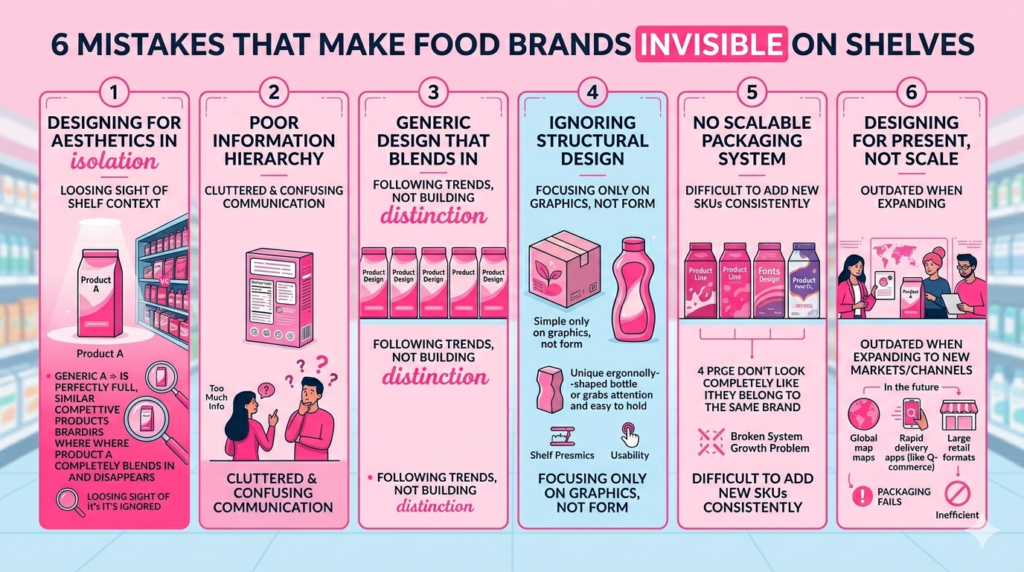
Most food brands don’t fail because of poor products. They fail because they are not seen. In a retail environment, whether it is a supermarket shelf, a café display, or a quick-commerce listing, your product is never viewed in isolation. It is always placed next to competitors that are fighting for the same attention, the same decision, and the same moment. This is where food packaging design becomes critical.
Packaging is not just about how your product looks. It is about how your product performs in a real-world environment where attention is limited, choices are overwhelming, and decisions are made in seconds. Research consistently shows that most purchase decisions are made within a few seconds of seeing a product. In that short window, your packaging must attract attention, communicate what the product is, signal value and quality, build trust, and differentiate from competitors. If it fails at any of these, the result is simple, the product is ignored.
Packaging Design should be treated as a business tool, not a design exercise.
Understanding the Role of Food Packaging Design
Before going into the mistakes, it is important to understand what packaging is actually responsible for. A well-designed food package performs across three layers, and most brands only focus on one of them. This creates a gap between how packaging looks and how it performs in reality.
The first layer is visual communication, which includes colour, typography, layout, imagery, and brand identity. Its role is to attract attention and communicate instantly within a few seconds. The second layer is structural function, which defines how the product exists physically through packaging format, material, usability, and logistics, directly impacting cost, durability, and user experience.
The third layer is commercial performance, which is often ignored but directly affects shelf visibility, conversion rate, perceived value, and repeat purchase. Most brands focus heavily on how packaging looks and ignore how it performs. That imbalance is where most problems begin.
Mistake 1: Designing for Aesthetics Instead of Shelf Context
One of the most common mistakes in food packaging design is designing the pack in isolation. Designs are often reviewed on screens, mockups, or clean backgrounds, but they are rarely tested in the real environment where they will compete. This creates a disconnect between how the design is perceived internally and how it performs externally.
Retail shelves are crowded and chaotic, with dozens of competing products that often share similar colours, formats, and visual patterns. A design that looks minimal or premium in isolation can completely disappear in this environment. The product does not stand out, the brand is not immediately recognizable, and it ends up blending into competitors, leading to low pick-up rates and poor conversion.
Packaging must be designed with context awareness, which means studying competitor shelves, identifying category patterns, and intentionally breaking them. Strong packaging always answers one critical question, what does this look like when placed next to 20 competitors?
Mistake 2: Poor Information Hierarchy and Cluttered Communication
Food packaging is a communication medium, not a canvas, but many brands try to include everything on the front of the pack. This creates clutter and confusion, making it difficult for the customer to understand the product quickly. Consumers do not read packaging in detail, they scan it, and if your packaging does not communicate clearly within a few seconds, it is ignored.
Weak hierarchy shows up when everything feels equally important, the product name is not clear, the benefit is not obvious, and the brand is forgettable. Good packaging, on the other hand, follows a clear communication order where the customer understands what the product is, why they should care, what makes it different, and which brand it belongs to. Everything else should support these answers instead of competing with them.
This is solved through typography scaling, contrast, focal points, and controlled information density, which ensures that the packaging guides the eye instead of overwhelming it.
Mistake 3: Generic Design That Blends Into the Category
Most food categories suffer from visual sameness because brands tend to follow trends instead of building distinction. This often happens due to heavy reliance on references, copying what already works, and avoiding risk in design decisions. While this approach may feel safe, it results in packaging that feels familiar but not memorable.
In crowded categories, familiarity without distinction leads to invisibility because there is no reason for the customer to choose one product over another. The packaging does not create recall, and over time, the brand loses its ability to stand out in the market. This directly affects both first-time purchase and long-term brand building.
Differentiation must be intentional, which means identifying category clichés, deciding what to follow and what to break, and building a distinct visual language that the brand can own. Check like what we did here in this work of a Chicken First Brand named The Chickster.
Mistake 4: Ignoring Structural Packaging Design
Many brands treat packaging as only graphic design, but packaging has two critical components, visual design and structural design. While graphics handle communication, structure defines how the product exists physically and how it is experienced by the user. Ignoring this layer limits the overall effectiveness of packaging.
Structure affects shelf presence, usability, logistics, cost, and perceived value, making it a key part of packaging performance. A unique form can improve recall, better usability enhances customer experience, and efficient formats reduce operational costs. However, most brands default to standard formats without questioning whether structure itself can be a differentiator.
Structural thinking should start early in the process by asking whether the form stands out, improves usability, and supports logistics. When done right, structure becomes a competitive advantage instead of just a container.
Mistake 5: No Scalable System for Multiple SKUs
Many brands design packaging for a single product without thinking about how the system will scale as the brand grows. This creates problems when new SKUs are introduced because there is no consistent structure to build on. As a result, each product starts looking different, and brand consistency begins to break.
Without a system, shelf recognition reduces because the customer cannot easily identify the brand across different variants. This weakens the brand’s presence and makes expansion more difficult. In contrast, a strong packaging system allows easy expansion, faster rollout of new products, and stronger recognition across all SKUs.
A scalable system includes a defined layout structure, clear variant logic, typography consistency, and flexible rules that allow adaptation without losing identity.
Mistake 6: Designing for the Present, Not for Scale
Most packaging decisions are made based on current needs without considering future growth. As brands expand, they enter new markets, introduce more SKUs, adapt to different retail formats, and shift towards quick-commerce platforms. If packaging is not designed with this in mind, it quickly becomes outdated.
This leads to frequent redesigns, increased costs, and broken brand consistency, which slows down growth instead of supporting it. Packaging should be treated as a long-term asset that evolves with the brand rather than a short-term design solution. It should be adaptable across formats, markets, and platforms from the beginning.
Designing for scale ensures that the brand can grow without losing clarity, consistency, or efficiency.
The Core Issue: Packaging Without Strategy
All of these mistakes come from one root problem: packaging without strategy. When decisions are based on trends and references, packaging becomes decoration, but when decisions are based on context, behaviour, and positioning, packaging becomes a growth tool. This shift in thinking is what separates average brands from scalable ones.
Effective packaging should consistently deliver high shelf visibility, clear communication, strong differentiation, scalable systems, alignment with brand positioning, and consistency across retail and digital platforms. Most importantly, it should reduce the effort required for a customer to choose your product, making the decision faster and easier.
Final Thoughts
Packaging is often the first and most important interaction a customer has with your brand. If it fails to attract attention, communicate clearly, or differentiate, the product does not get a chance. Good packaging does not just look good; it performs under real-world conditions where competition is high and attention is limited.
If you are planning a new product launch, redesign, or expansion, packaging needs to be approached as a system, not a one-time design.