


Opening your first restaurant is emotional. It’s personal. It’s often a dream that’s been building for years. But opening your second outlet? That’s where reality hits. Because the truth is this: most restaurant brands don’t fail on Day 1. They fail right after initial success. They fail when they try to scale. The first outlet works. The buzz is real. Weekends are packed. Reviews look promising. And then comes the decision: “Let’s open another one.”
And suddenly, everything starts breaking. This is not just bad luck. It’s structural. In fact, restaurant failure is rarely about food. It’s about foundation, brand, and systems. This blog breaks down why most restaurant brands fail before their second outlet and, more importantly, how to fix it before it’s too late.
The Myth: “If One Outlet Works, Scaling Is Easy”
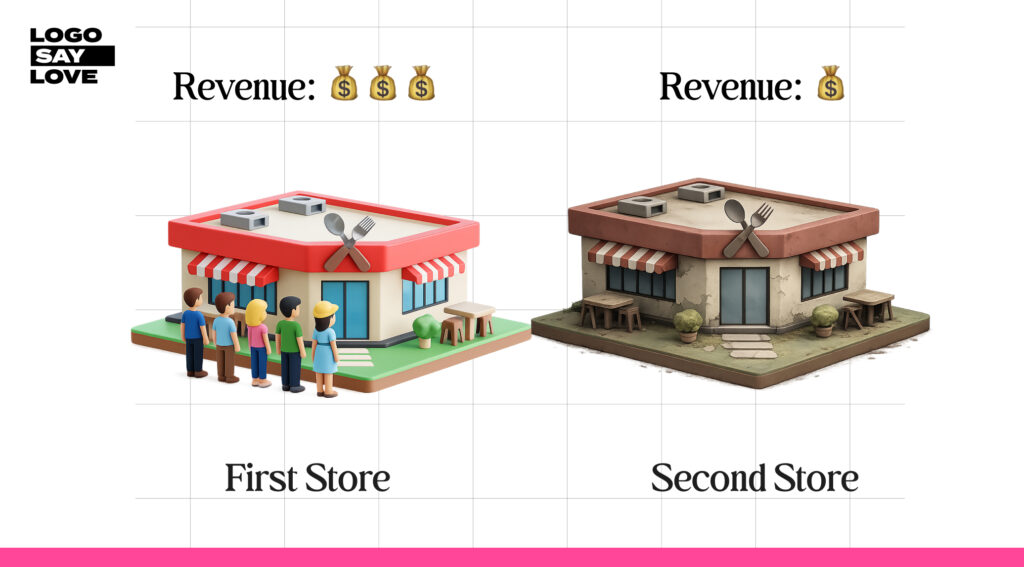
Opening a second outlet is not just an expansion decision. It is a test of whether the restaurant is built on a scalable foundation. Many restaurants succeed in their first location because of location advantage, early hype, and heavy founder involvement. But when restaurants expand, they need brand clarity, repeatable systems, and consistent execution across locations. This is where restaurants either scale smoothly or start to break.
The Real Problem: Weak Brand Foundations
Most restaurants start with food, interiors, and location, but delay the most important layer: brand strategy. Without a clear brand foundation, every decision becomes reactive instead of intentional. A strong restaurant brand is not just a logo or an aesthetic. It is a defined positioning, a clear audience, and a consistent experience across every touchpoint.
Before expanding to a second outlet, restaurants must build a brand strategy that clearly defines positioning, brand story, tone of voice, and experience guidelines. This creates a strong foundation that ensures consistency across locations and hassle-free decision-making as the restaurant/ cafe grows.
1. Lack of Clear Brand Identity
Many restaurants struggle to scale because they are unclear about who they are. Identity is often mistaken for visual design, but branding is about meaning and perception. Without clarity on who the brand serves, what it stands for, and why it exists, the brand becomes interchangeable. This leads to inconsistent communication, unclear positioning, and a lack of memorability.
Fix: Define a clear brand identity before expanding. This includes brand purpose, positioning, personality, visual identity, and messaging. When restaurants build a clear identity system, every new outlet becomes easier to align and scale. It enables the entire team to grow in sync without too many moving pieces, all focused in one direction.
2. The “Hype Bubble” Problem
Most restaurants experience an initial surge driven by curiosity, social buzz, and novelty. But novelty fades. Over time, footfall stabilises or drops because dining behaviour is driven by the desire to try something new. Without systems to drive repeat visits, restaurants face declining retention even before opening a second outlet.
Fix: Build systems that encourage repeat behaviour and loyalty. This includes loyalty programmes, community engagement, content strategy, and brand storytelling that builds long-term affinity rather than relying on initial discovery.
3. Inconsistent Customer Experience
Consistency is one of the biggest challenges when restaurants scale. Customers expect the same quality of food, service, ambience, and packaging across all locations. Inconsistencies in taste, service, or brand experience can immediately break trust. This often happens because operations rely heavily on the founder’s intuition or individual staff members.
Fix: Standardise operations through documented processes. Develop SOPs, staff training frameworks, menu standardisation, and brand experience guidelines. Consistent brand experience across outlets is what turns a restaurant into a reliable brand.
4. No Differentiation in a Crowded Market
The food and beverage industry is highly competitive. Without clear differentiation, restaurants blend into the crowd. Competing only on menu variety or pricing makes a brand forgettable. What works in one neighbourhood does not automatically translate to another if the brand lacks a strong core idea.
Fix: Build a differentiated brand narrative and own a clear positioning in the market. Define what makes the brand unique, create signature experiences, and communicate consistently across all customer touchpoints. Differentiation is what makes expansion sustainable.
5. Financial Blind Spots
A busy restaurant does not always mean a profitable restaurant. Many founders underestimate costs, misprice menus, or lack clarity on unit economics. When opening a second outlet, costs multiply across rent, staffing, and operations. Without strong financial systems, losses can grow faster than revenue.
Fix: Build financial clarity before scaling. Track key metrics such as food cost percentage, labour cost percentage, average order value, and break-even timelines. Use this data to ensure profitability is repeatable across locations.
6. Weak Marketing and Digital Presence
Relying only on walk-ins and word of mouth limits growth. In today’s market, discovery happens online. Restaurants that do not invest in digital presence struggle to attract consistent demand. A second outlet without a strong digital footprint takes longer to gain traction.
Fix: Invest in digital presence before expanding. Focus on local SEO, content strategy, social media storytelling, and performance marketing. A strong digital engine supports discovery, trust, and repeat visits across locations.
7. Overdependence on the Founder
Many restaurants operate successfully because the founder is deeply involved. But when a restaurant depends on one person for decision-making, quality control, and problem-solving, scaling becomes difficult. A second outlet cannot function sustainably if everything depends on the founder.
Fix: Build a team and systems that operate independently of the founder. Document decision-making frameworks, delegate responsibilities, and build leadership structures. A scalable restaurant is built on systems, not individuals.
8. Scaling Without Systems
Scaling is not about opening another location. It is about replicating success consistently and profitably. Restaurants that scale successfully rely on documented processes, data-driven decisions, and repeatable systems.
Fix: Before opening a second outlet, build systems that support consistency across operations, brand experience, marketing, and financial performance. When systems are in place, scaling becomes predictable instead of chaotic.
Final Thought: The Second Outlet Is a Test, Not a Milestone
Opening your second outlet is not a success. It’s validation. It tests your brand, systems, strategy, and most importantly, it reveals whether you’ve built something scalable or situational. Because in the restaurant business, you don’t fail because you started wrong. You fail because you tried to grow something that was never built to scale.