

The modern consumer doesn’t browse. They scan, swipe, and decide. In a supermarket aisle, on a quick-commerce app, or while scrolling Instagram, your brand has less than three seconds to make an impression. Not ten. Not five. Three. And in that moment, everything is decided. Whether your product gets picked, ignored, or forgotten.
This is the reality of building an F&B brand today. It is no longer just about taste or quality. It is about how quickly you communicate value, how clearly you position yourself, and how effectively your brand earns attention. Because in today’s market, attention is not a metric. It is currency.
The Death of Passive Attention in FMCG
A decade ago, brands could rely on repetition. TV ads, billboards, and print campaigns created familiarity over time. Consumers would eventually remember you. That world is gone. Today’s consumer, especially Gen Z, is exposed to thousands of brand messages daily. The result is not engagement but filtration. People are constantly deciding what deserves their attention and what does not. Research shows that:
- Consumers now operate within a 3-second decision window for content and products
- Attention is 8x more predictive of brand recall than traditional metrics like views
- Even a 5% increase in attention can double brand perception
This shift has fundamentally changed FMCG marketing. It is no longer about visibility. It is about immediate relevance.
The Shelf Battle: Where Brands Win or Disappear
Walk into any supermarket. Look at the snack aisle. What do you see? Hundreds of options. Similar colors. Similar claims. Similar pricing. Now imagine a consumer standing there. They are not analysing. They are reacting. In fact, over 70% of purchase decisions are made in-store, often within seconds. This is where packaging becomes your most powerful marketing tool.
What Happens in Those 3 Seconds:
- The eye scans for contrast
- The brain looks for familiarity or intrigue
- The hand moves toward what feels right instantly
There is no time for explanation. Only perception. This is why packaging is not design. It is a strategy.
Why Most F&B Brands Fail the 3-Second Test
Despite knowing the importance of attention, most brands still operate as if attention is abundant. Here’s where they go wrong:
1. They Communicate Features, Not Benefits
Consumers don’t care about what your product is. They care about what it does for them. “High protein snack” is a feature. “Stay full without guilt” is a benefit. And benefits are what register instantly.
2. They Overcrowd Their Packaging
Too many claims. Too many colours. Too much text. Clarity wins in chaos. Always.
3. They Ignore Shelf Context
Your packaging does not exist in isolation. It exists beside competitors. If it does not stand out in that environment, it does not exist.
4. They Treat Branding as an Afterthought
Branding is often seen as a finishing step. In reality, it should be the starting point. Because in FMCG, your brand is what gets you picked before your product gets experienced.
The Rise of Micro-Moment Marketing
Today’s consumer journey is no longer linear. It is fragmented into micro-moments.
- A reel was watched while waiting for coffee
- A quick Blinkit search during work
- A supermarket grab between calls
Each of these moments lasts seconds. And brands must be designed for these moments. This is where short-form marketing becomes powerful. It is not about making content shorter. It is about making it sharper.
The 3-Second Hook: What Actually Works
Winning attention is not luck. It is structured. Here’s what consistently works in today’s landscape:
1. Lead With Emotion
People react before they think. Curiosity, humour, surprise, or relatability. These are your entry points.
2. Make It About the Consumer
Nobody is looking for your brand. They are looking for themselves. Your messaging should reflect their lifestyle, not your product specs.
3. Show, Don’t Explain
Visual communication is faster than verbal. This is why bold packaging, strong colours, and clear hierarchy outperform detailed descriptions.
4. Be Instantly Clear
If someone has to “figure out” your product, you have already lost. Clarity is not boring. It is powerful.
Packaging as Your Fastest Salesperson
In FMCG, your packaging does three jobs simultaneously:
- Grabs attention
- Communicates value
- Builds trust
All within seconds.
Elements That Drive High-Impact Packaging:
- Color Psychology: Green for health, black for premium, red for urgency
- Typography Hierarchy: What you read first matters most
- Whitespace: Reduces cognitive load and improves clarity
- Structure & Shape: Differentiation beyond graphics
And most importantly:
Your packaging should answer one question instantly:
“Why should I pick this?”
Why Healthy Snacking Brands Are Winning
The modern consumer is not just buying food. They are buying identity. Healthy snacking brands are thriving because they align with:
- Fitness-driven lifestyles
- Clean eating habits
- Convenience-led consumption
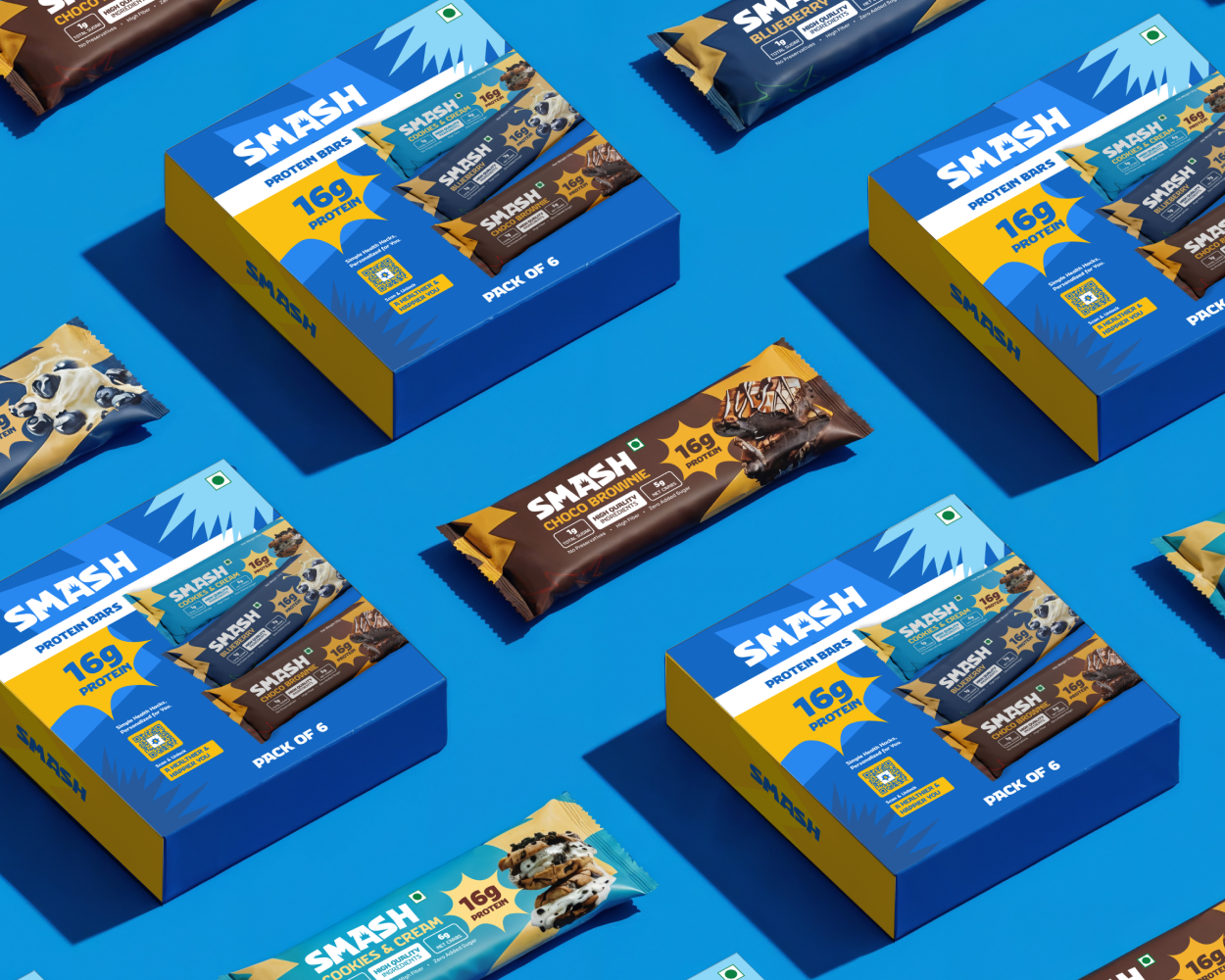
This creates a powerful intersection of need + aspiration. For example, brands like Smash Protein Bars succeed because they:
- Align with a lifestyle, not just a category.
- Communicate benefit instantly (protein, energy, convenience)
- Use bold, clear packaging
From Packaging to Perception: The Branding Multiplier

Packaging gets you picked once. Branding gets you picked again. To build a scalable F&B brand, you need consistency across:
- Packaging
- Social content
- Website
- Ads
- Messaging
This is where our Brand Strategy & Foundation becomes critical. Because without a strong foundation, your brand becomes inconsistent. And inconsistency kills recall.
- A strong brand narrative
- Signature experiences
- Clear category ownership
The Attention Economy Formula for F&B Brands
Let’s simplify what winning brands are doing differently.
| Factor | Old Approach | New Approach |
| Attention | Assumed | Earned instantly |
| Packaging | Functional | Strategic |
| Messaging | Informational | Emotional + Clear |
| Content | Long-form | Short-form, high-impact |
| Branding | Aesthetic | Experience-driven |
Where Most Brands Miss the Opportunity
The biggest mistake brands make is treating attention as a creative problem. It is not. It is a strategic alignment problem. If your:
- The product does not align with consumer trends
- Packaging does not stand out
- Messaging is not clear
- Content is not relevant
Then no amount of marketing will fix it.
- Don’t track unit economics
- Misprice menus
- Ignore cost structures
How to Build a 3-Second-Ready F&B Brand
Here’s a practical framework:
1. Define Your Instant Value Proposition
What does your product offer in one line? If it takes more than one sentence, refine it.
2. Design for the Shelf First
Before thinking digital, think physical. Will your product stand out in a crowded aisle?
3. Build Visual Consistency
Your Instagram, packaging, and website should feel like one brand.
4. Invest in Packaging Strategy
This is where our Packaging Design & Brand Experience service becomes a growth driver, not a cost.
5. Create Scroll-Stopping Content
Short videos, bold visuals, and relatable messaging. Not ads. Content that feels native.
6. Test and Iterate
Attention is dynamic. What works today may not work tomorrow. Winning brands evolve constantly.
The Future Belongs to Fast, Clear, Human Brands
The 3-second rule is not a limitation. It is a filter. It forces brands to:
- Be clearer
- Be sharper
- Be more human
Because when attention is scarce, only the most relevant brands survive. And in FMCG, relevance is not built over time anymore. It is decided instantly.
Final Thought
If your brand cannot communicate its value in three seconds, it will not survive in today’s market. But if it can? It will not just get noticed. It will get chosen. And in a world of endless options, being chosen is everything.